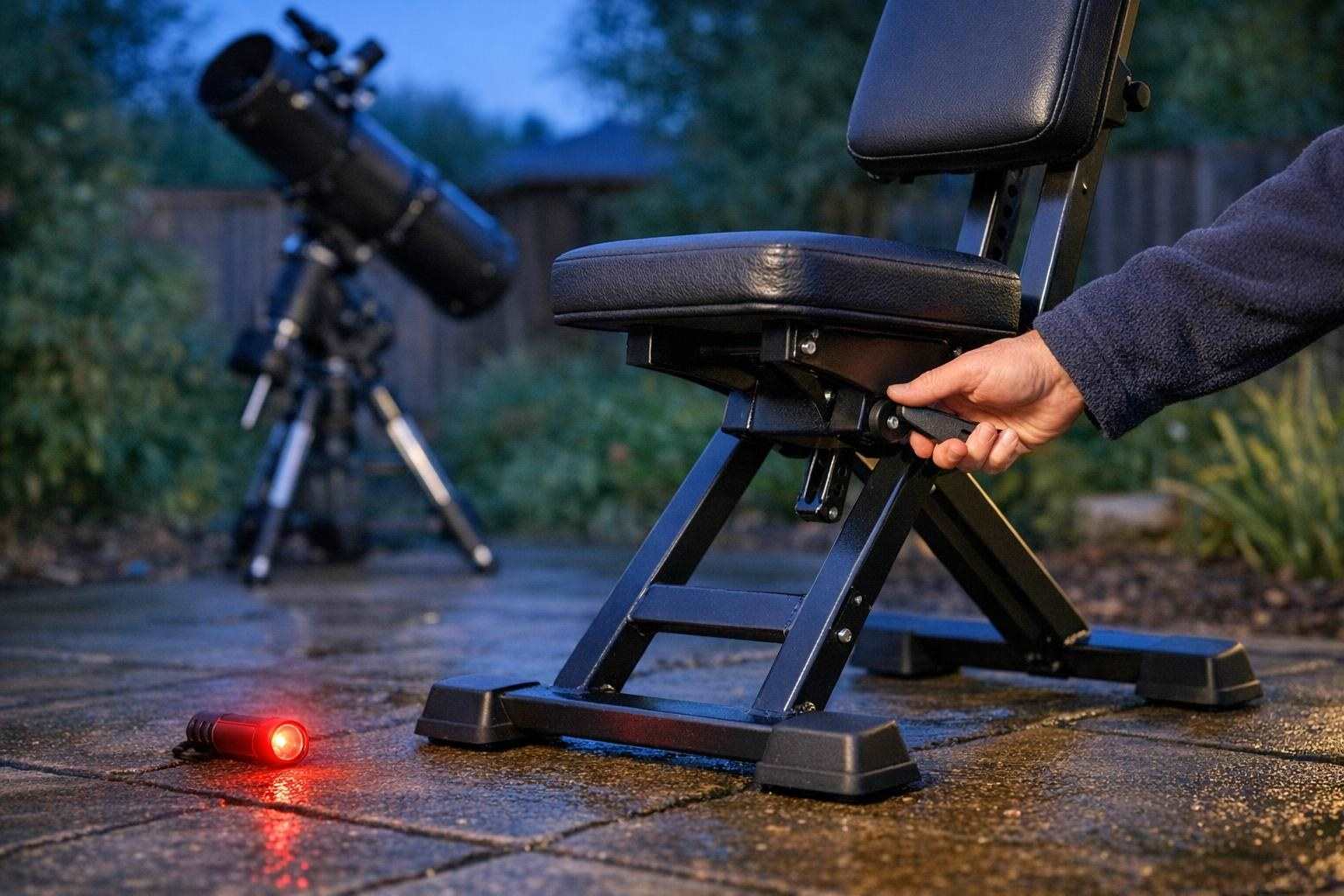
When we say 'comfortable' in observing we are not talking about pumping up the seat with extra soft padding. A comfortable observing seat for long sessions is one which allows us to support our backs adequately but also allow us to turn freely. Some observers find that a backrest of modest dimensions is all they require. Others prefer a totally open design which allows for easy movement to and fro as we observe in comfort.
Match the seat to your observing position
Before buying, test the chair with your telescope at the different viewing heights. A Refractor may sit on the ground with the eyepiece at about waist height, a Reflector may have the eyepiece at hip height or a little above, a Spotting Scope will have the eyepiece at about eye level and a Telephone Tube Telescope at about shoulder height.
Useful astronomy chairs can be adjusted to different heights without having to be taken down and reassembled. This allows for easier use when following a list of objects to be viewed, or when using different magnifications to view the same object. Adjustable seats need to have a wide enough range of adjustment, and the means to make the adjustment needs to be quick to use in the dark, and to lock the seat at the chosen height.
Before you look for the chair, test out different observing positions. These are the different ways you sit at your telescope to look at objects of different heights in the sky. A good astronomy chair will let you change height quickly without having to break your setup, so test out different positions and see how much you have to move around. Can you sit or stand and look through the eyepiece?
Stability matters more than extra padding
It's possible that soft cushioning may feel good in a short shop test but does not translate into a stable seat. Look for a seat that has a wide enough base to sit steady on rough ground and be able to withstand your weight. Small movement is distracting when trying to view through an eyepiece and thus must be avoided at all costs.
Look for a chair with stable feet on the surface where you will use it. This could be grass, gravel, tarmac, or even a pavement or deck. A chair with very small feet could sink into soft ground. Chairs with very smooth feet could slip on hard surfaces. And if the legs of a chair are not exactly the same height then the seat could tilt or even fall.
While sitting slowly on the seat with your full weight test for any clicking or creaking, also check all joints, fasteners and lock points for any signs of wear or movement. Even though these signs don't necessarily mean that the item will fail, it is wise to inspect them before using the item to support your delicate telescope equipment.
Make adjustments simple in the dark
Night time astronomy involves lots of different actions with your telescope. You may wear gloves, have to use red lights and want to avoid banging the tripod. Therefore, a simple turn of a knob to make some height adjustments needs to be easily located by touch in the dark. Furthermore, it should be clear when it has been released from its locked position.
Before selecting a model check for easily located controls that can be operated by touch and provide obvious confirmation of operation. Check that lock release mechanisms provide a positive operation (i.e. do not release accidentally) and do not have an 'unexpected free fall' when unlocked. Also test that the locking action holds securely at all heights and does not require excessive force to lock and unlock.
Test out a chair at different heights before a long observing session to make sure the frame remains level, the locks open and close properly and the chair moves up and down smoothly. Don't attempt to use piles of books, wobbly boxes etc to raise up to viewing height. They may seem like a good temporary solution but are a huge risk and are not worth it for a small convenience.
Inspect wear before it becomes a problem
These items can be damaged by damp grass and other outdoor items that are left to sit on the seat of your chair after you have gone inside for the night. Even when stored indoors, chairs can pick up dust, and undergo changes in temperature and humidity. So occasionally wipe down your chair with a dry cloth and then store it dried. Also check for grit and other dirt in any moving parts.
Be able to spot common defects: split or worn seats, stretched stitching, bent tubes, loose rivets, cracked plastic parts, corroded fasteners, a locking pin that no longer fits properly, play in the frame, a seat leg that no longer sits properly on the ground. Don't assume minor defects are of no consequence – they can deteriorate rapidly.
Be sure to follow any care or repair recommendations from the manufacturer. For example, lubricants can attract dirt and make a problem worse than good, and some finishes or fabrics can be damaged by certain liquids. If in doubt as to the function of a part, or the best way to repair it, it's generally better to seek the advice of a qualified person and then replace the part as necessary rather than risk damage by attempting to repair it yourself.
Choose comfort that supports concentration
When choosing an observing seat for stargazing comfort the observer needs to feel supported enough in order to remain seated for long periods, and yet have enough room to easily get up in order to adjust a tripod for example, change an eyepiece etc. Some observers prefer the support of a modest back rest, others prefer to have plenty of room to sit in an open configuration in order to easily get up and about when needed.
In fact much outdoor clothing is bulky and means that what seems like a good seat in shops can feel very different in practice. And cotton, or similar material seats, will feel very cold and uncomfortable if they get wet in damp or wet conditions. A removable seat cover would seem to be a good idea, but it needs to be made of material that can be easily cleaned and dried and must not be left against the frame when wet.
We consider a number of aspects in choosing an Observing Chair. As we are often moving them around the yard, we consider weight and folded size. Sometimes the Chair will be situated close to the Telescope, so we consider quick adjustment and storage protection of the Chair. Cables, cases and tripod legs should be kept clear of the sitting area and observers should have room to stand with their feet back without getting tangled up in any of the equipment.
Know when to replace rather than repair
Your observing chair should receive the same sort of preventative checks as any of your other telescope accessories. Check the feet, the frame, the seat's attachment to the frame and the height lock for your seat before each long observing session. Problems with your chair can reveal themselves quickly when the telescope is on the ground and it is still light outside.
Just because you can fix something does not mean you should. If the component in question is load-bearing, there are no repair instructions available, or you would end up altering the original design or structure in the process of fixing it, it's time to look for a good replacement.
The best observing seat is the one that allows you to sit comfortably with good posture while making sure your movements are predictable. It should be used around the position of your telescope, tested on the surface where you intend to use it and warning signs of wear and tear taken seriously.